
When traveling with a power wheelchair or scooter, charging your batteries is something you absolutely have to get right. Run out of power in a place you don’t know, and your trip goes sideways fast. The good news is that most modern wheelchair chargers work fine in Japan with just a cheap plug adapter. But “most” isn’t “all,” and figuring out which camp you’re in takes about 30 seconds of checking a label.
This page walks through exactly what you need to know, based on where you’re traveling from.
Japan’s Electricity: The Basics
Japan runs on 100 volts at 50Hz (eastern Japan, including Tokyo) or 60Hz (western Japan, including Osaka, Kyoto, and Hiroshima). That’s the lowest voltage of any country you’re likely to be traveling from.
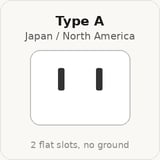
The outlets use Type A plugs: two flat parallel pins, no ground pin. They look almost identical to North American outlets, except there’s no third hole for a ground prong.
Step 1: Check Your Charger Label
Before anything else, find the label on your charger (the box/brick that connects to the power cord, not the cord itself). Look for the input voltage rating. It will say one of two things:
This means the charger is universal/dual-voltage. It can handle any voltage from 100V to 240V, which covers every country in the world. Only a plug adapter is needed to physically fit the outlet. No voltage conversion required.
This means the charger is single-voltage and was built for one country’s power only. A voltage converter/transformer is needed in addition to a plug adapter. More on that below.
The quick version: If the label says “100-240V,” a plug adapter is all that’s needed. If it shows a single number, keep reading.
Most wheelchair and scooter chargers made in the last 10 years use switching power supplies and are universal voltage (100-240V). But older models may be single-voltage. Always check the label or call the dealer before traveling. Don’t guess.
Step 2: What You Need (By Country)
Coming from the US or Canada (120V, Type A/B plugs)
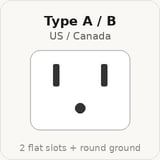
If the charger is 100-240V (universal): The plug will physically fit Japan’s outlets since they’re the same Type A shape. The only issue is if the plug has three prongs (Type B with a ground pin). Japan’s outlets don’t have a ground hole, so a simple 3-prong to 2-prong adapter is needed. These cost a few dollars and weigh almost nothing.
Recommended adapters:
- TESSAN 2-Prong to 3-Prong Adapter with 4 Outlets and USB ports (good for also charging a phone)
- VINTAR 2-Prong to 3-Prong Outlet Adapter (compact, with 2 AC outlets and 2 USB ports)
If the charger is single-voltage (120V only): The gap between 120V (US) and 100V (Japan) is small, and in practice many 120V devices will run at 100V, though perhaps slower or less efficiently. However, this is not officially recommended and could shorten the life of the charger. For safety, a step-up transformer is the better option:
- VCT VT-500J Step Up/Down Voltage Transformer (~$55, 500 watts, handles most wheelchair chargers)
- LiteFuze JP-1000 Step Up/Down Transformer (1000W, with circuit breaker protection)
These transformers weigh 2-3 kg, so keep that in mind for packing.
Coming from Europe (220-240V, Type C/E/F plugs)
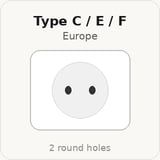
If the charger is 100-240V (universal): A plug adapter that converts the European round-pin plug (Type C, E, or F) to Japan’s flat-pin Type A is all that’s needed. A universal travel adapter that includes a Type A output works well.
- Europe to US/Japan Plug Adapter (converts EU/UK/AU plugs to Type A)
If the charger is single-voltage (220-240V only): This is where it gets important. Japan’s 100V is less than half of what the charger expects. It simply won’t work without a step-up transformer, and trying to use it without one means the charger won’t function (it won’t charge the batteries, or will charge extremely slowly).
A step-up transformer that converts Japan’s 100V up to 220-240V is required. Make sure the transformer’s wattage rating is higher than the charger’s power draw. For most wheelchair chargers, a 500W transformer is enough, but check the charger label for its watt rating.
- Yinleader 500W Step Up/Down Voltage Transformer (converts 110V to 220V and vice versa)
Coming from the UK, Singapore, Malaysia, Hong Kong, UAE, or Kenya (220-240V, Type G plugs)
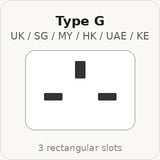
These countries all use the same Type G plug with three rectangular pins. If buying a wheelchair in any of these countries, the charger plug will be the same shape.
If the charger is 100-240V (universal): A plug adapter that converts the Type G three-rectangular-pin plug to Japan’s two-flat-pin Type A is needed. These are widely available.
- Go Travel UK to Japan Compact Adaptor (~£6, compact and lightweight)
If the charger is single-voltage (220-240V only): Same situation as Europe above. Japan’s 100V is far below what the charger needs. A step-up transformer is required (see the Europe section above for recommendations).
Coming from Australia, New Zealand, or Argentina (220-230V, Type I plugs)
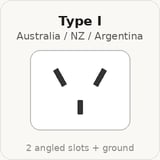
If the charger is 100-240V (universal): A plug adapter that converts the angled-pin plug (Type I) to Japan’s flat-pin Type A is needed.
- AU to Japan Travel Adapter (Type I to Type A)
If the charger is single-voltage (230V only): Same as Europe and UK. A step-up transformer is needed. See the Europe section for recommendations.
Coming from South Korea, China, India, South Africa, or other 220V countries (Type C and other round-pin plugs)
Many countries across Asia, Africa, the Middle East, and South America use some variation of the round-pin plug (Type C, D, F, or M) at 220-240V. This includes South Korea, China, India, Indonesia, Thailand, Vietnam, South Africa, Nigeria, Brazil, Chile, Colombia, and Saudi Arabia, among others.
If the charger is 100-240V (universal): A universal travel adapter that outputs Japan’s Type A (two flat pins) is all that’s needed. Since round-pin plug shapes vary between countries, a universal adapter that accepts multiple input types is the safest bet.
- Universal to US/Japan Plug Adapter (accepts EU, UK, AU, and other plug types, outputs Type A)
If the charger is single-voltage (220-240V only): Same as Europe. Japan’s 100V is far below what the charger expects. A step-up transformer is needed, plus a plug adapter. See the Europe section for transformer recommendations.
Coming from Taiwan (110V, Type A/B plugs)
Taiwan uses the same plug type and similar voltage (110V) as North America. Chargers from Taiwan will physically fit Japan’s outlets without any adapter. If the charger has a ground prong, a 3-to-2 prong adapter may be needed. See the US/Canada section above.
Plug Adapter vs. Voltage Converter: What’s the Difference?
This is where a lot of people get confused, so here’s the simple version:
A plug adapter changes the shape of the plug so it physically fits the outlet. It does NOT change the voltage. Think of it like an extension cord with a different plug shape on each end. They cost a few dollars and weigh next to nothing.
A voltage converter (also called a transformer) actually changes the electrical voltage from one level to another. These weigh 2-5 kg for a 500W unit and cost $40-80. Only needed if the charger can’t handle 100V.
Where to Buy in Japan (If You Forgot Something)
If you arrive in Japan and realize you need an adapter or converter:
- Electronics stores (Yodobashi Camera, Bic Camera, Yamada Denki) carry plug adapters easily. Voltage converters/transformers are harder to find and may not be in stock.
- Airport shops at Narita, Haneda, and Kansai airports usually have basic plug adapters.
- Amazon Japan (amazon.co.jp) delivers quickly within Japan, often next day. Note that a separate Amazon Japan account is needed (a regular US/UK Amazon account won’t work), but the site is available in English. Search for 変圧器 (hen’atsuki) for voltage transformers, or 変換プラグ (henkan puragu) for plug adapters. Before ordering, check that the item can be delivered to your hotel address, as not all products ship to every location.
Recommendation: buy what you need before leaving home. It saves money and avoids the stress of hunting for a transformer in a foreign city.
FAQ (Based on Real Traveler Questions)
No. A charger rated 100-240V is universal and will work with Japan’s 100V power. All that’s needed is a plug adapter to physically fit the outlet. If the plug has three prongs (common in North America), a 3-to-2 prong adapter is needed since Japanese outlets don’t have a ground hole.
Check the label on the charger to confirm the voltage rating. Many portable scooter chargers are 100-240V universal. If it is universal, just a European-to-Type A plug adapter is needed. If it’s 220-240V only, a step-up transformer is required.
Contact the wheelchair/scooter dealer and ask specifically: “Is my charger rated for 100V, 50/60Hz?” They can answer definitively. You can also post a photo of the charger label on tabifolk and the community can help figure it out.
If the plug is the standard two-prong (Type A) with no ground pin, it will physically fit Japan’s outlets with no adapter needed. If it has three prongs, the 3-to-2 adapter is required. Either way, check the voltage rating first.
Japanese hotels use the same Type A outlets as everywhere else in Japan. Some newer hotels may have universal outlets or USB charging ports built into the nightstand, but don’t count on it. The outlet by the bathroom mirror (for shavers) is sometimes labeled 100V/240V, but these are usually low-wattage and not suitable for charging a wheelchair.
Yes, as long as the transformer’s wattage rating exceeds the charger’s power draw. Most wheelchair chargers draw 200-400 watts, so a 500W transformer gives headroom. If the charger draws more (check the label), a larger transformer is needed.
Generally yes, the same as at home. Just make sure the setup (charger + any adapter or transformer) is on a hard, flat surface with good ventilation. Don’t drape anything over the charger or transformer while it’s running, as they generate heat.
Bottom line: For most travelers with power wheelchairs or scooters, the answer is simple: check the charger label, and if it says 100-240V, buy a cheap plug adapter and you’re done. The people who need to do more planning are those with older, single-voltage chargers, particularly those coming from 220-240V countries (Europe, UK, Australia) where the voltage gap with Japan is large.
When in doubt, call the dealer before the trip. And if you have questions, post them on tabifolk. Someone in the community has probably dealt with the exact same situation.
Some links on this page are affiliate links. If you purchase through them, Accessible Japan earns a small commission at no extra cost to you.